
New students
Unblocker
Finds the hold that is blocking enrollment and routes it to the office that owns it, so the student sees exactly what is missing and who resolves it.
holds · office directory
DiaCroma™ for Education
How many of yours left over a hold nobody explained, a scholarship average nobody warned them about, or a requirement nobody told them had opened? The DiaCroma AI Tutor helps each student decide their next step — inside your university’s own app, in time to stay enrolled.
In the U.S., 3 in 10 first-year students had left the institution where they started before their second year began.
National Student Clearinghouse Research Center · Persistence and Retention, fall 2024 cohort: 69.1% second-fall retention · source
The cost
The starting values are only an example. Move each slider to match your institution.
A scenario built from your own numbers, not a promise of results. The proof of concept measures the real effect in your institution, against success criteria agreed before it starts. And because the costly model never decides, guiding every student stays affordable.
One student, two endings
Ana is ready to enroll for her next term. The system won’t let her. The deadline is August 15.
Nobody decided to lose her. Nobody told her what to do.
One question. One step. In time.
A dashboard would flag her. A bot would quote the rule. The AI Tutor tells her what to do.
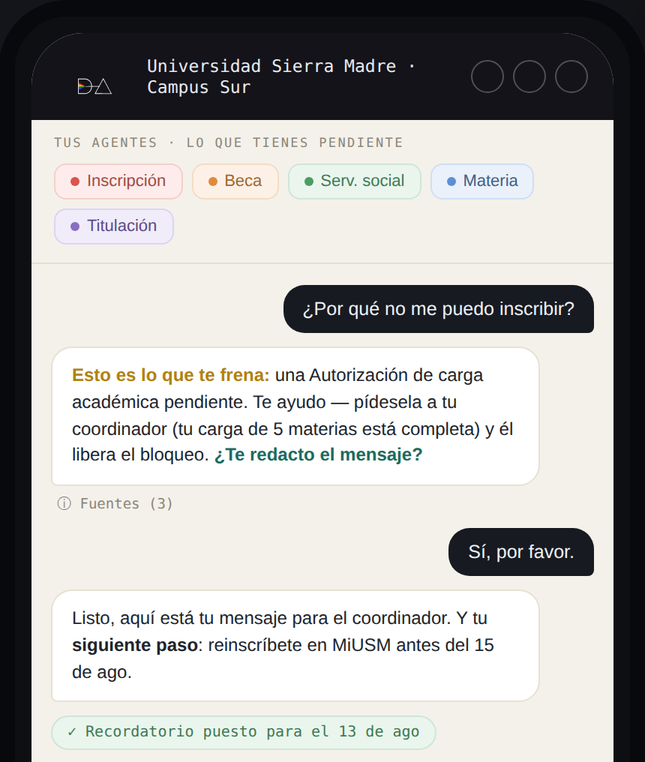
The real app answering exactly this question (in Spanish). Ana is illustrative.
Why it keeps happening
| Bot | Dashboard | AI Tutor | |
|---|---|---|---|
| Talks with the student directly | ✓ | — | ✓ |
| Knows this student’s live situation: record, holds, scholarship, balance | — | partial · no input from the student | ✓ |
| Helps the student make the best decision toward their goal | — | — | ✓ |
| Cites a source for every answer, with a record you can defend | partial | — | ✓ |
Each tool as it works on its own. A bot answers and stops; a dashboard flags a student and waits for someone to act. That follow-up does not always come.
What your institution learns
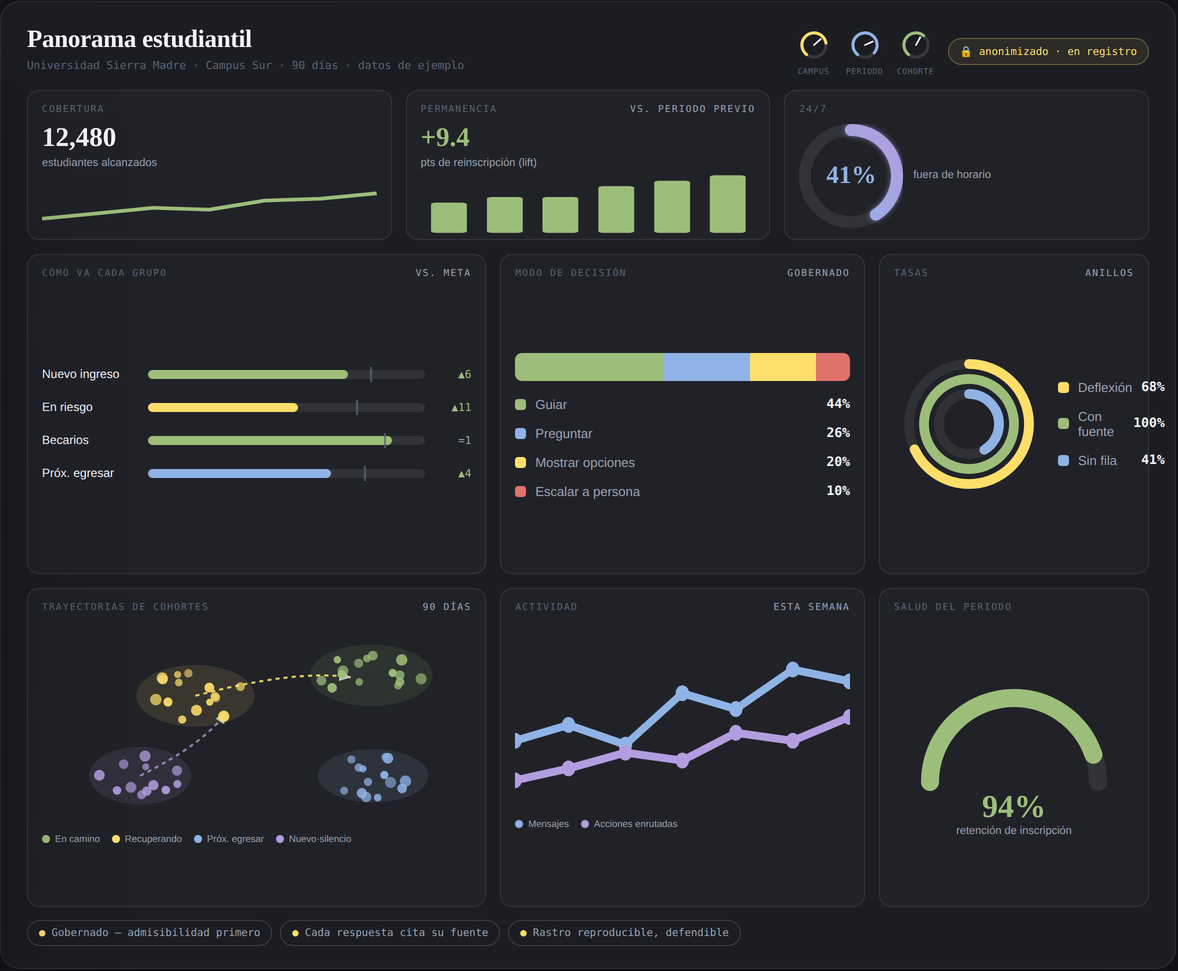
What could a school finally see if it could tell which students are quietly slipping, before they’re gone? Every conversation shows where students get stuck, which groups fall behind their goal and how each decision was made — so your leadership fixes the cause, not one case at a time.
DiaCroma™ for Education · AI Tutor
The engine behind every student who stays: it understands the person and helps them make the best next decision — with published science behind every step.
The voice is the commodity. The decider is the thing no one else has.
What sets it apart · DiaCroma AI Tutor
In a randomized trial at Harvard, students with an AI tutor learned more than twice as much as in an active-learning class, in less time.
The authors are clear that the result depended on design: instructors wrote step-by-step solutions into the model’s instructions to keep it accurate, and they warn that hallucinations and over-reliance remain real risks. DiaCroma AI Tutor builds those safeguards into the architecture instead of the prompt.
Read the student’s question and turn it into a precise request.
Machine learning to understand the student, code to hold the limits. The language models never decide.
Puts the decision into clear words. Nothing more.
| The AI tutor in the study | DiaCroma AI Tutor | |
|---|---|---|
| Where accuracy comes from | Step-by-step solutions written into the model’s prompt | Decisions made by the engine against your verified course material |
| What the language model decides | The tutoring response, guided by the prompt | Nothing. It reads the question and words the answer |
| The risks the authors flag | Hallucinations and over-reliance | The decision cannot drift or flatter, and every step is on the record |
Comparison based on the design described in the published study.
How it decides
What keeps a student enrolled is the decision behind the words. The AI Tutor relies on four pillars to decide:
What they are trying to do, where they left off, and the real limits they live inside: time, money, energy.
Verified material, regulations, programs, deadlines and offices.
Under a strict order of truth: a live record beats a document, which beats a claim.
Curated best practices for students in this situation — a guide, never an override.
Before it chooses, it removes what isn’t allowed for that student. Four hard gates, every time: feasible, safe, legal, legitimate. The wrong move never even competes. Then one of four answers:
Explain, give a hint, move the student forward.
Only what it needs to decide well.
When the trade-off is genuinely open.
If it doesn’t know or shouldn’t act, it says so, or hands the case to your staff.
The science
| What the student experiences | Why it keeps them enrolled | Research |
|---|---|---|
| It never proposes something they can’t or shouldn’t do | No advice that lands them in a bigger problem | Admissibility-First Decision Control · The Four Admissibility Gates |
| It works on what is really holding them back, instead of asking for “more effort” | The real obstacle gets fixed: capacity, willingness or coordination | The Multiplicative Execution Bottleneck |
| It speaks to this student, with their time, money and energy — not to an average | A plan they can actually carry out | Temporal Feasibility and Causal Credit |
| It looks after steady habits, not bursts of effort | Progress that lasts through a hard semester | Habit Stability |
| When it isn’t sure, it says so and asks | Trust: it never invents an answer about their future | Honest Belief Under Imperfect Evidence · Decision Honesty Under Uncertainty · Typed Decision Output |
| It learns each student without learning its way past the limits | Better every term, never bolder | The Learning Boundary · Human Constraints as Mathematics |
| It measures what really worked, without claiming what would have happened anyway | A retention number your board can trust | Temporal Feasibility and Causal Credit |
“Who decided you didn’t get the scholarship: a person, or a score nobody can explain?”
That is the first of fifteen questions in the DiaCroma manifesto. Ten research papers stand behind the answers, and the method is protected by U.S. Patent Application No. 19/640,556.
The result that matters: the student who makes it to graduation.
DiaCroma™ for Education · Beyond
Retention is where it starts. What follows: the student’s whole journey, the AI agents across your campus, and each learner, for life.
Any hour, in your university’s name. One answer, one next step.
Every moment of the student’s path
Each situation on a student’s path has its own journey. It reads observable evidence — never a risk score — and takes the one next step toward the student’s goal, inside your rules.
Finds the hold that is blocking enrollment and routes it to the office that owns it, so the student sees exactly what is missing and who resolves it.
Warns the student before the next payment that puts the scholarship at stake — only if they consented. Without consent, it does not send.
With two or more independent signals, it proposes one concrete recovery step and cites the evidence. With one weak signal, it asks before acting.
When silence crosses a threshold, it sends one warm message — and does not repeat it inside its window.
Names the next missing document against its deadline. When two paths are both good — the fastest, or the one with the nearest deadline — it shows both.
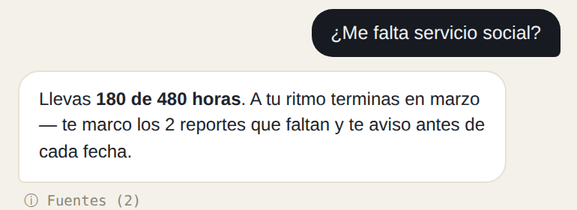
Tells the student when a requirement opens — in Mexico, social service once 70% of credits are earned — something the system can compute and nobody tells them.
For the student, every day
In one place
Enrollment, scholarship, social service, courses, graduation: each student sees what is open and what comes next.
It keeps count
With a warning before each deadline.
Around the clock
Answers at any hour from your regulations, calendars and offices, giving your staff their hours back. When a person is needed, the case arrives with full context, not a cold ticket.
Beyond the student app
Agents built in Microsoft Copilot Studio, in Foundry or in your own code can run under DiaCroma for Agents. What each agent may do is checked against everything it has already done, before it acts — the same discipline that protects your students, applied to every agent on campus.
Your own DiaCroma

Your knowledge base, your rules and limits, your offices and your brand, owned and maintained by your institution. With a clear agreement on who does what: data ownership, security, operations, human escalation, reporting and continuous improvement.
Fewer traditional students, degrees that carry less weight on their own, and AI changing what is worth learning. The institutions that come out ahead will serve each person for life: as students, as alumni, as professionals who come back. DiaCroma knows each learner over time.
DiaCroma™ for Education · How to start
With your students, through DiaCroma for Education, or with your institution, through veritAI. You choose where to begin.
 DiaCroma for Education
 veritAI
 · the first 90 days
veritAI is Verit’s transformation practice. We don’t ask you to stop running your institution: sessions of 60–90 minutes per leader per week, pre-scheduled, each with a defined output. We prepare everything; you receive outputs, not homework.
Leadership interviews, an inventory of ungoverned AI and a review of your systems. First findings by week 2.
The maturity matrix per department, your appropriate risk level, each leader’s profile and benchmarking against institutions like yours.
Specific initiatives with owners, governance gates and measurable outcomes, and a return your CFO can defend.
The four outputs, assembled into one system and in use. From Day 91, a critic agent improves it with every query.
Flagship research or tuition-driven private; COPAES, FIMPES, SACSCOC and QS accreditation; the faculty adoption curve; student continuity. veritAI’s maturity framework has eight levels; its universities edition is coming soon:
| Level | In a university |
|---|---|
| L0 · Governance | Protects compliance and institutional accreditation. |
| L1 · Augmented departments | Student-success AI and early-alert models. |
| L2 · Data foundation | Unifies enrollment, registrar, LMS and advising data. |
| L4 · Role-aware surfaces | Provosts, deans, advisors and registrars, each with their own decision context. |
| L7 · Portfolio intelligence | Enrollment competition, labor-demand signals and alumni-network intelligence. |
DiaCroma™ for Education · Questions
How it fits your university, where your data lives, and what it does in the hard cases.
How it fits your university
Your information and your channels stay yours. We bring the decision.
IT and legal
No. The decision belongs to the AI Tutor, inside limits it cannot cross; the language model decides nothing. See how.
In your institution’s environment, behind your single sign-on, from day one. If you prefer, Verit operates it for you.
Yes. It is designed so every decision is written to a record your team can replay: what was weighed, what was set aside, and why.
It does not counsel. It routes to your wellbeing team, and it never follows up unless the student does.
Scholarship and payment warnings go only to students who consented; without consent, nothing is sent.
No. You start small: see How to start.